News & Updates
How to Choose a Customs Agent in Ireland
A practical guide to choosing a customs agent in Ireland: experience, cut-off times, data quality, record access and the agency, in-house or hybrid decision for UK and Ireland trade.
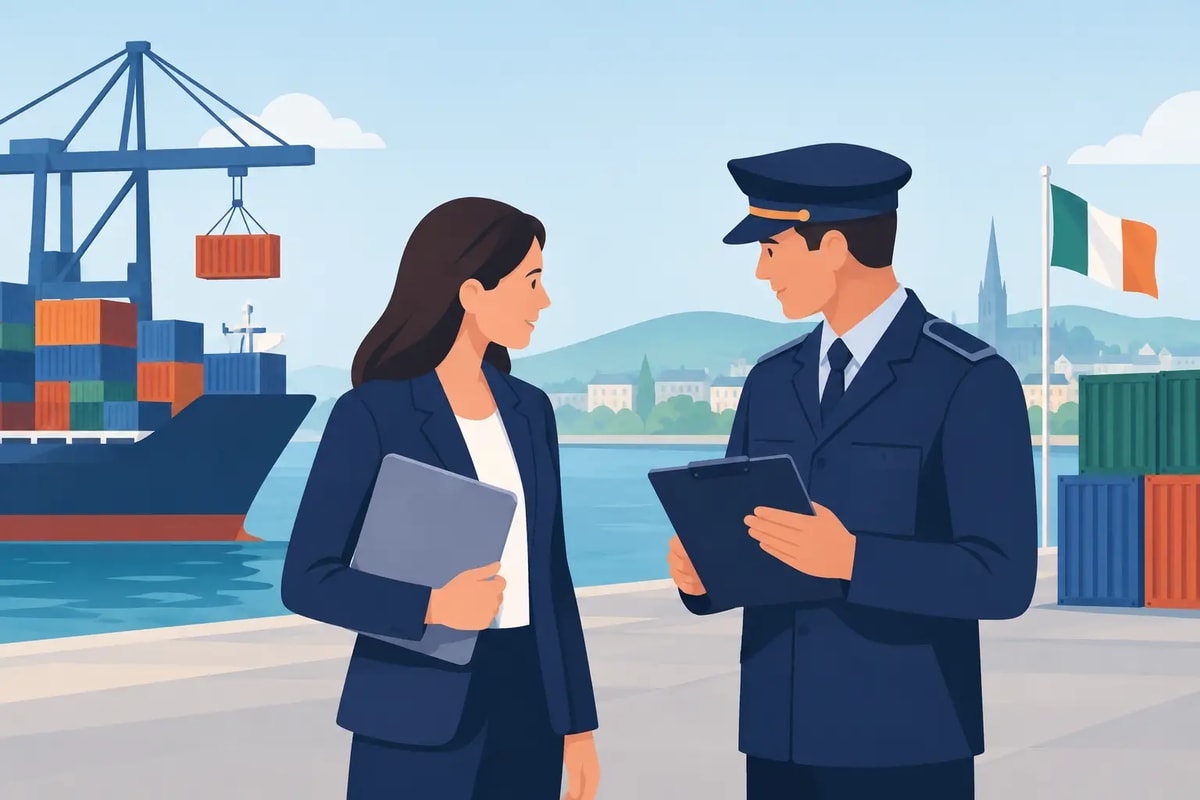
A truck delayed at Dublin Port or Holyhead rarely has one simple cause. A missing commodity code, an incomplete invoice, an incorrect customs value or a declaration submitted too late can all stop goods moving. A customs agent Ireland businesses can depend on helps prevent those operational problems before they become storage charges, missed delivery slots or unhappy customers.
For businesses trading between Great Britain and Ireland, the right agent is not simply someone who can submit a declaration. They should understand the movement behind it: the goods, the commercial terms, the route, the port process and the systems involved on both sides of the Irish Sea. That matters whether you import occasionally, dispatch daily groupage, operate a haulage fleet or manage customs for multiple customers.
When do you need a customs agent in Ireland?
If goods move between Great Britain and Ireland, customs formalities will usually be part of the process. The exact requirements depend on the direction of travel, the goods and the route. Ireland remains within the EU customs territory, while Great Britain is outside it. Northern Ireland has separate arrangements that need to be assessed carefully for each movement.
A customs agent can prepare and submit import and export declarations, but the best support begins earlier. They should help identify what information is needed from your commercial and logistics teams so declarations can be completed accurately first time.
This is particularly useful where internal knowledge is limited, volumes are growing quickly or staff are being pulled away from their main roles to deal with customs queries. It can also make sense for experienced operators during peaks, holiday cover or when a new trade lane is being introduced.
Outsourcing does not remove your responsibility as importer or exporter. Your business remains responsible for the accuracy of the information supplied and for meeting duties, VAT and record-keeping obligations. The agent should make those responsibilities clear, not obscure them.
What a good customs agent should handle
A capable agent works from complete, validated data rather than trying to repair a shipment after it reaches the border. For a standard movement, that often includes commodity codes, goods descriptions, quantities, values, origin, Incoterms, transport details and the correct party details.
They should also understand the operational messages around the declaration. Depending on the route, this may involve safety and security filings, transit procedures, pre-lodgement requirements, vehicle movement references and port systems. A declaration alone is not always enough to get a vehicle checked in and on its way.
For UK and Ireland movements, ask how the agent supports workflows such as CDS, ROS, GVMS, PBN, ENS, S&S GB and NCTS6. You may not need every service, but an agent that understands how these processes connect is less likely to treat customs as an isolated back-office task.
Representation is another practical point. Confirm whether the agent acts as a direct or indirect representative, what this means for your business, and how authority to act will be documented. This should be agreed before your first shipment, not during a time-sensitive clearance.
Choosing a customs agent in Ireland
Price matters, but the cheapest per-declaration rate can be expensive if it comes with limited support, unclear cut-off times or repeated errors. The better comparison is the total cost of keeping freight moving: declaration charges, administration time, delays, amendments, demurrage and the pressure placed on your own team.
Check experience against your actual movements
Ask about the routes and goods you move, rather than accepting broad claims of customs expertise. A business importing pallets through Dublin Port has different requirements from a haulier moving accompanied freight via Holyhead, or an exporter using transit to move goods onwards through Europe.
Certain sectors also need more specialist knowledge. Food, alcohol, chemicals, controlled goods, excise products and goods requiring licences can create additional requirements. An agent does not need to replace your product compliance expertise, but they should recognise when a shipment needs further checks before it is declared.
Look for clear cut-offs and escalation routes
Customs is time-sensitive. You need to know when data must be provided, what happens if paperwork arrives late and who deals with a query outside normal office hours. A good agent provides realistic cut-off times and a clear escalation route for urgent movements.
This is especially important for groupage and high-frequency traffic. One incomplete consignment can affect a full trailer, so your agent should have a process for identifying missing data early and communicating with the relevant party quickly.
Ask how data is collected and checked
Many declaration errors begin with inconsistent commercial data. For example, a vague goods description such as “parts” provides little basis for classification, while a declared value that does not match the invoice will trigger questions later.
Find out whether the agent accepts data by portal, template, system integration or email, and how exceptions are managed. The best method depends on your volume. Email may be workable for occasional shipments, but it creates avoidable risk when dozens of declarations are needed each day.
Make sure you can access your records
Your business should be able to retrieve declaration references, supporting documents and reports without chasing an inbox. These records are needed for audits, VAT accounting, internal reconciliation and customer queries.
Ask how long records are retained, how they are provided and whether you can see the status of submissions. Visibility is valuable even when you fully outsource the declaration work.
Agency, in-house software or a hybrid model?
There is no single right operating model. An outsourced customs agency service is often the sensible choice for lower volumes, complex goods or businesses without trained customs staff. It gives you expert support without building a full internal operation.
In-house customs software can give higher-volume traders more control. Your team enters and manages declarations directly, works from its own commercial data and can respond quickly when transport plans change. However, it requires trained people, documented procedures and ongoing attention to customs updates.
A hybrid approach is often the most practical option. Your team can process routine declarations in-house while using customs specialists for unusual movements, classification questions, transit, staff cover or periods of exceptional demand. This avoids making an all-or-nothing decision about outsourcing.
Custran supports this model by combining customs software, agency processing, training and operational support. The aim is straightforward: give businesses the control they need, with expert help available when a movement is not routine.
Prepare your business before the first declaration
The fastest declaration is one supported by reliable data. Before appointing an agent, make sure your teams can consistently provide correct invoices, packing lists, commodity codes, EORI details, origin information and transport instructions.
It is also worth agreeing who owns each part of the process. Sales may issue invoices, purchasing may hold supplier data, warehouse teams may confirm quantities, and transport teams may have the ferry booking or vehicle registration. Without a clear handover, information arrives late or contradicts itself.
For regular movements, create a simple shipment checklist and review the first few declarations closely. Look for recurring questions from the agent. Those questions usually reveal a gap in master data, supplier paperwork or internal ownership that can be fixed once rather than handled shipment by shipment.
Questions to ask before you appoint an agent
Before committing, ask how the agent handles your specific routes, which customs and port systems they connect to, and what information they need before a declaration can be lodged. Clarify their cut-off times, amendment process, record access and out-of-hours support.
You should also ask what happens when customs raises a query or goods are selected for intervention. A reassuring answer is not simply “we will deal with it”. It is a clear explanation of who contacts whom, what documentation may be required and how your transport operation will be kept informed.
The right customs partner should make day-to-day trade feel controlled, not mysterious. Start with your real movements, your internal capability and the level of visibility you need. From there, choose support that keeps goods moving while giving your team a practical route to stronger customs control.