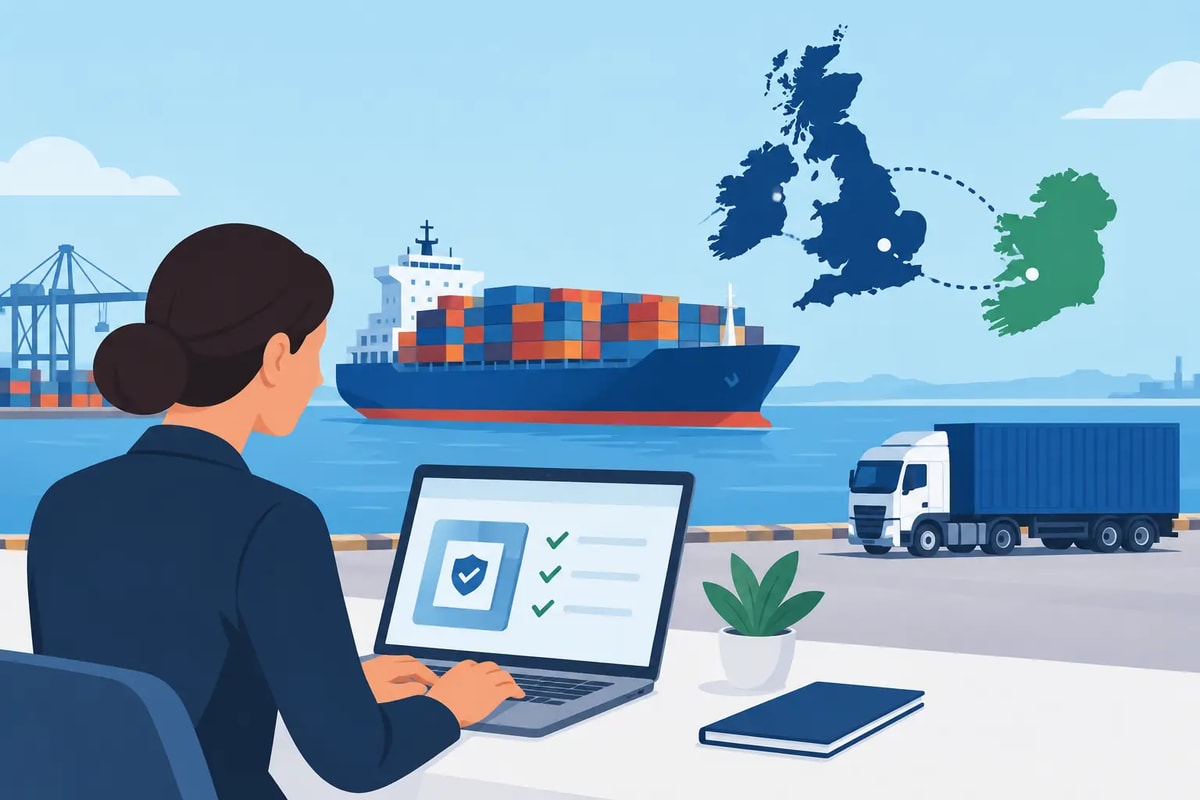
A trailer can be loaded, booked and on its way to the port, yet still miss its sailing because an ENS is incomplete, late or filed against the wrong movement. Knowing how to file ENS is therefore not just a customs administration task. It is a practical control that protects delivery schedules, driver time and customer commitments.
ENS means Entry Summary Declaration. It is a safety and security declaration submitted before goods arrive at a border. It gives border authorities advance information about the goods, the parties involved and the transport movement so they can assess risk before arrival.
For businesses moving goods between Great Britain, Northern Ireland, Ireland and the wider EU, the process depends on the route and the applicable safety and security system. The core discipline is the same: establish who is responsible, gather accurate commercial and transport data early, submit within the correct deadline, and retain evidence that the declaration was accepted.
Start by identifying the ENS requirement
An ENS is separate from the import declaration. It does not determine customs duty, VAT or commodity-code treatment, although much of the underlying data should be consistent. Its purpose is safety and security. Treating it as an afterthought to the customs entry is a common cause of avoidable disruption.
For goods entering Great Britain, safety and security declarations are generally made through the S&S GB service. For goods entering Ireland or another EU member state, ENS requirements sit within the EU Import Control System 2, known as ICS2. Northern Ireland follows EU safety and security rules, which can make the route materially different from a movement into Great Britain.
The party with the legal obligation is usually the carrier bringing the goods into the customs territory. In practice, that responsibility may be fulfilled by a haulier, ferry operator, freight forwarder or customs intermediary, depending on the commercial arrangement and the available data. Do not assume that a carrier booking means the carrier has filed the ENS. Confirm this in writing before the vehicle or unit is released.
The exact requirement also depends on whether the movement is accompanied or unaccompanied, the mode of transport and where the goods are first entering the territory. A truck travelling from Great Britain to Ireland has a different filing journey from a container arriving directly into Ireland from a non-EU country. Build the route check into the booking process, not the day of departure.
How to file ENS without creating a border problem
The most reliable process starts before the goods are packed. Filing can be completed in-house through an approved connected system, or by an agent acting on your instruction. Either model can work well. The right choice depends on declaration volumes, staff capability and how quickly your transport information becomes final.
1. Confirm the filer and the system
First, agree who will submit the declaration and which system they will use. A business filing its own ENS needs the appropriate registrations, system access and a process for receiving acceptance or rejection messages. If a forwarder or agent will file, they need complete and timely information from the exporter, importer and carrier.
Responsibility should be unambiguous. Record the filer's name, the expected submission deadline, the transport reference they require and who will act if the sailing, vehicle registration or routing changes. This matters outside normal office hours, when a missed message can quickly become a missed crossing.
2. Assemble accurate shipment data
An ENS is only as reliable as the information provided. Gather the data from source documents rather than relying on shorthand descriptions copied from a booking email. At a minimum, the filer will normally need details of the consignor and consignee, the carrier, the place of loading and arrival, the transport equipment or vehicle, and the route.
Goods descriptions need particular care. “Parts”, “samples”, “general cargo” or “mixed freight” may be commercially familiar, but they do not provide a meaningful safety and security description. Use a clear description that says what the goods are. For example, “stainless steel kitchen sinks” is more useful than “household goods”.
The relevant commodity code is often required as well. Check that it matches the product being shipped and aligns with the later import declaration where one is needed. Inconsistencies do not always stop a movement immediately, but they create questions, rework and a weaker audit trail.
Other data may include package counts and types, gross weight, container or trailer numbers, seals, dangerous goods indicators and the parties' EORI details. The precise fields vary by system and movement, but the operational rule is simple: complete the data set while the people closest to the shipment can still validate it.
3. Submit before the applicable deadline
ENS deadlines vary by transport mode and route. Deep-sea container traffic, short-sea ferry movements, road freight, rail and air cargo do not operate to one universal time limit. EU and Great Britain requirements also differ.
For that reason, do not set an internal rule such as “file every ENS two hours before arrival” and assume it covers every movement. Use the deadline applicable to the entry location, mode and service. Build in a sensible buffer for late paperwork, booking changes and system interruptions.
For regular trailer operations, a practical approach is to set a cut-off when the export paperwork and transport details must be supplied to the ENS filer. That internal cut-off should be earlier than the legal submission deadline. It gives the team time to correct missing EORI numbers, unclear descriptions or mismatched trailer details without putting the sailing at risk.
4. Check acceptance, not just submission
A declaration sent is not necessarily a declaration accepted. Your process should capture the message or reference returned by the relevant safety and security system and make it visible to the transport team.
The reference needs to be matched to the correct consignment and movement. If an agent files on your behalf, ask for confirmation in a consistent format, ideally before the truck is called forward or the unit is delivered to the terminal. A simple status record showing ‘data received’, ‘ENS accepted’ and ‘movement departed’ is often enough to prevent assumptions between teams.
5. Amend when the movement changes
Transport changes are normal. A trailer can be re-booked to a later sailing, switched to another vehicle or routed through a different port. Commercial details may also change after the first filing.
When that happens, assess whether the ENS must be amended or replaced. Do not leave an accepted declaration in place simply because it was accepted initially. The declaration must reflect the movement that actually takes place. Assign one person or team to own amendment decisions so drivers, planners and declarants are not each assuming someone else has updated the record.
The data checks that save the most time
Most ENS errors are not complex customs interpretation issues. They are handover failures. The commercial team may hold the goods description, the warehouse has the package count, the transport planner has the ferry reference, and the declarant receives the information too late to query it properly.
Before filing, check that the consignor and consignee details are complete; the EORI information is valid where required; the goods description is specific; package and weight details are credible; and the trailer, container or vehicle data matches the booked movement. Also confirm the first point of entry rather than relying on the final delivery address. A consignment destined for Dublin but arriving through another EU port must be considered against its actual entry route.
For groupage, establish who holds responsibility for the house-level information. A master-level transport record alone may not contain enough data for the individual consignments carried within it. This is particularly important for forwarders and 3PLs consolidating freight from multiple customers.
Should you file ENS in-house or outsource it?
In-house filing gives you control and can be efficient for businesses with predictable volumes, trained staff and good access to shipment data. A connected customs platform can reduce rekeying, provide structured validation and keep declaration records alongside other border processes.
Outsourcing may be the better option where volumes are occasional, routes are complex or internal teams cannot monitor movements outside office hours. The trade-off is that an agent can only act as quickly and accurately as the information supplied. Outsourcing responsibility does not remove the need for disciplined data ownership.
Many businesses choose a hybrid model: routine movements are processed in-house, while unusual routes, urgent amendments or capability gaps are supported by a customs specialist. Custran can support that model with software, operational support, training and agency services, allowing teams to process declarations in-house while retaining experienced backup when needed.
Build ENS into the transport plan
The strongest ENS process is not owned by one person in the customs team. It is shared across sales, warehouse, transport planning, finance and any external logistics partners. Each party should know what data they own, when it must be available and who must be told when something changes.
Start with one recurring lane and map the process from order release to arrival. Identify the filer, the system, the legal deadline, your earlier internal deadline, the acceptance evidence and the amendment route. Once that is working consistently, apply the same controls to other lanes.
A well-filed ENS rarely attracts attention, which is exactly the point. When safety and security data is accurate, timely and tied to the real transport movement, your team can focus on moving goods rather than explaining why they are waiting at the border.