News & Updates
UK Ireland Transit Guide for Hauliers and Traders
A UK Ireland transit guide for hauliers and traders: identifying the route, when Common Transit Convention movements make sense, building the declaration pack and avoiding port delays.
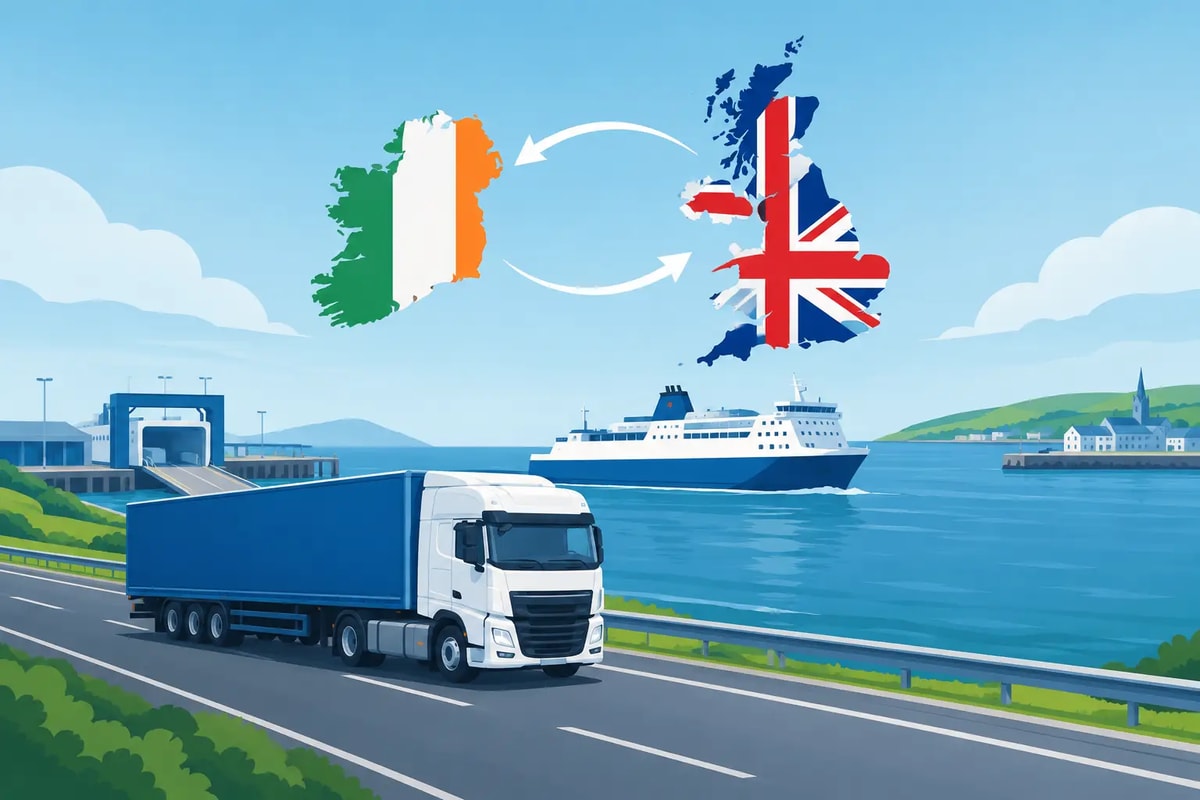
A truck held at check-in because a movement reference number is missing can disrupt an entire delivery plan. This UK Ireland transit guide is designed for the teams who need goods to move reliably between Great Britain, Northern Ireland, Ireland and mainland Europe, while keeping customs responsibilities clear.
The right process depends on the route, the customs status of the goods and whether they are travelling under a transit procedure. The most common mistake is treating every Irish movement as the same. Ireland is in the EU customs territory; Great Britain is not. Northern Ireland has a separate practical position for goods movements. A direct ferry, a route through Great Britain and a movement under the Common Transit Convention can each require different declarations, references and checks.
UK Ireland transit guide: identify the route first
Before anyone prepares a declaration, confirm the physical route. Customs systems need to reflect how the goods will actually travel, not simply where the buyer or seller is based.
For goods moving directly from Great Britain to the Republic of Ireland, businesses will normally need a Great Britain export declaration and an Irish import declaration. Safety and security requirements and carrier pre-lodgement steps also apply. The haulier needs the correct references before arriving at the port, and the Irish importer needs a clear plan for customs clearance, duty, VAT and any licences or certificates.
For goods travelling between Ireland and mainland Europe via Great Britain, the UK landbridge may still be commercially attractive. However, the goods are entering and leaving a non-EU customs territory. Using the Common Transit Convention can keep the goods under customs control while they cross Great Britain, rather than requiring full UK import and export clearance for the landbridge leg. This is a transit movement, not a substitute for the export and import formalities required at the start and end of the commercial journey.
Movements between Northern Ireland and Great Britain, or Northern Ireland and Ireland, need their own assessment. The commodity, direction of travel, final destination and commercial purpose can affect the process. Do not assume that a process used for a GB to Ireland shipment applies to a Northern Ireland movement.
When customs transit is the right tool
Transit is designed for goods that need to move under customs supervision from one customs office to another before being released into a final procedure. It is particularly useful where goods are not yet in free circulation, where clearance will take place inland, or where an Irish-EU movement crosses Great Britain.
Under the Common Transit Convention, a transit declaration is generally submitted through NCTS6. Once accepted, it creates a Movement Reference Number, usually known as the MRN. That MRN follows the vehicle and the consignment through the journey. The movement must be presented, discharged and closed correctly at the office of destination. A transit declaration that is accepted but not properly discharged can create guarantee exposure and a time-consuming investigation.
Transit may be appropriate when an Irish importer wants goods to move from a port to an authorised inland location before import clearance. It may also be the practical choice for consolidated freight, where a forwarder controls the movement and individual import entries are completed at destination.
It is not automatically the best answer for every shipment. For a simple, direct GB to Ireland movement with clearance arranged at the port, standard export and import declarations may be more straightforward. Transit adds control and flexibility, but it also adds responsibilities: an authorised principal or representative, a valid guarantee where required, accurate routing, and reliable arrival and discharge procedures.
The difference between transit and a customs declaration
A transit declaration controls movement. It does not establish the customs value, tariff classification, origin or relief that determines the final import liability. Those matters still need to be correct when the goods are declared to the final import procedure.
That distinction matters operationally. A business can have a valid transit MRN and still face delay at destination if the Irish import declaration is incomplete, the commodity code is wrong or a sanitary, phytosanitary or other regulatory document is missing. Our customs declaration software keeps classification, values and document checks in one workflow.
Build the declaration pack before booking the ferry
The fastest border process begins before the vehicle is loaded. Commercial paperwork, master data and transport references should agree. If the invoice says one thing, the packing list another and the declaration a third, the driver and customs team are left resolving preventable queries under time pressure.
Start with the seller and buyer EORI numbers, full goods description, commodity code, quantity, weight, customs value, Incoterms, country of origin and destination. Confirm who is acting as exporter, importer and declarant. These roles are not interchangeable, and the commercial contract should support the customs arrangement.
For transit movements, also establish the office of departure, intended office of destination, any offices of transit, the means of transport, seal details where applicable and the guarantee arrangement. Where goods are grouped into one movement, make sure the item-level data is available and matches the load. A mixed trailer does not remove the need for precise data.
Certain goods require extra attention. Products of animal origin, plants, controlled goods, excise goods and dual-use items may have licences, pre-notifications or border control requirements beyond the core customs declaration. The correct transit route will not overcome missing product compliance.
Match government references to the operator’s workflow
A border movement can involve several systems, and each one serves a different purpose. The important operational question is not merely whether a reference exists, but whether it has been shared with the person who needs it at the next stage.
For Great Britain declarations, businesses may work with CDS and, depending on the route, Community System Providers. Goods Vehicle Movement Service, or GVMS, is used on relevant ferry routes to create a Goods Movement Reference from the customs references linked to that crossing. Safety and security declarations may be required through S&S GB for movements into Great Britain, while entry summary requirements into Ireland must be handled for the EU side of the journey.
In Ireland, import and transit-related processes interact with Revenue systems and port community workflows, including pre-boarding requirements on applicable routes. The exact procedure can differ by port, carrier and direction of travel. Check the carrier’s cut-off times and data requirements early. A correct declaration submitted after the carrier deadline can still mean a missed sailing.
Give drivers a concise movement pack: booking details, vehicle and trailer information, MRNs, the GMR where required, contact numbers and instructions for what to do if selected for a check. Drivers should not have to search through emails or call several people at the port gate.
Prevent the failures that cause port delays
Most disruption is caused by a small number of repeat issues. They are manageable when ownership is clear across sales, warehouse, transport and customs teams.
First, avoid vague goods descriptions such as “parts”, “samples” or “general cargo”. Customs declarations need descriptions that allow a product to be identified and classified. Secondly, do not reuse a previous commodity code without checking the current product specification and tariff treatment. A small product change can alter the classification, duty rate or licensing position.
Thirdly, ensure the declaration is submitted in the correct party’s name and with the right representation model. If an agent is filing on behalf of an importer, authority and EORI details must be in place. Finally, plan for arrival and discharge, not only departure. A transit movement is not complete when the ferry sails. Someone must monitor it through to closure and investigate exceptions promptly.
Choose an operating model your team can sustain
There is no single right model for every business. A frequent trader with trained staff may benefit from processing customs declarations in-house, retaining direct visibility over data and reducing dependency on external cut-offs. A business with irregular movements, specialist commodities or limited resource may prefer an agency to manage declarations. Many operators use a hybrid model: routine movements are processed internally, while complex routes, new product lines or peak periods are supported by customs specialists.
The practical test is whether your team can maintain accurate data, submit on time, respond to queries and retain a clear audit trail. Software should make these tasks easier, not hide the process behind unfamiliar terminology. Direct connectivity to customs systems, clear status updates and staff training make a meaningful difference when a vehicle is due at the port.
Custran supports this approach with customs software and expert assistance for businesses that want to process declarations in-house, outsource the work or combine both models. The priority is to make customs simple without reducing the controls needed to keep goods moving compliantly.
Keep the process current
Border procedures, carrier rules and product controls change. Review your route instructions after a new port is added, a supplier changes, a commodity range expands or a missed sailing exposes a gap. Keep a record of what failed, who resolved it and what should change in the next movement.
The most useful transit process is the one your warehouse, customs team, forwarder and driver can follow confidently at 5am on a busy sailing day. Clear ownership, accurate data and a checked route plan will do more for business continuity than a last-minute scramble at the port.