News & Updates
Agency versus Software for UK and Ireland Customs
Agency versus software for UK and Ireland customs: what each model means, when outsourcing wins, when in-house declarations give better control and why a hybrid approach often works best.
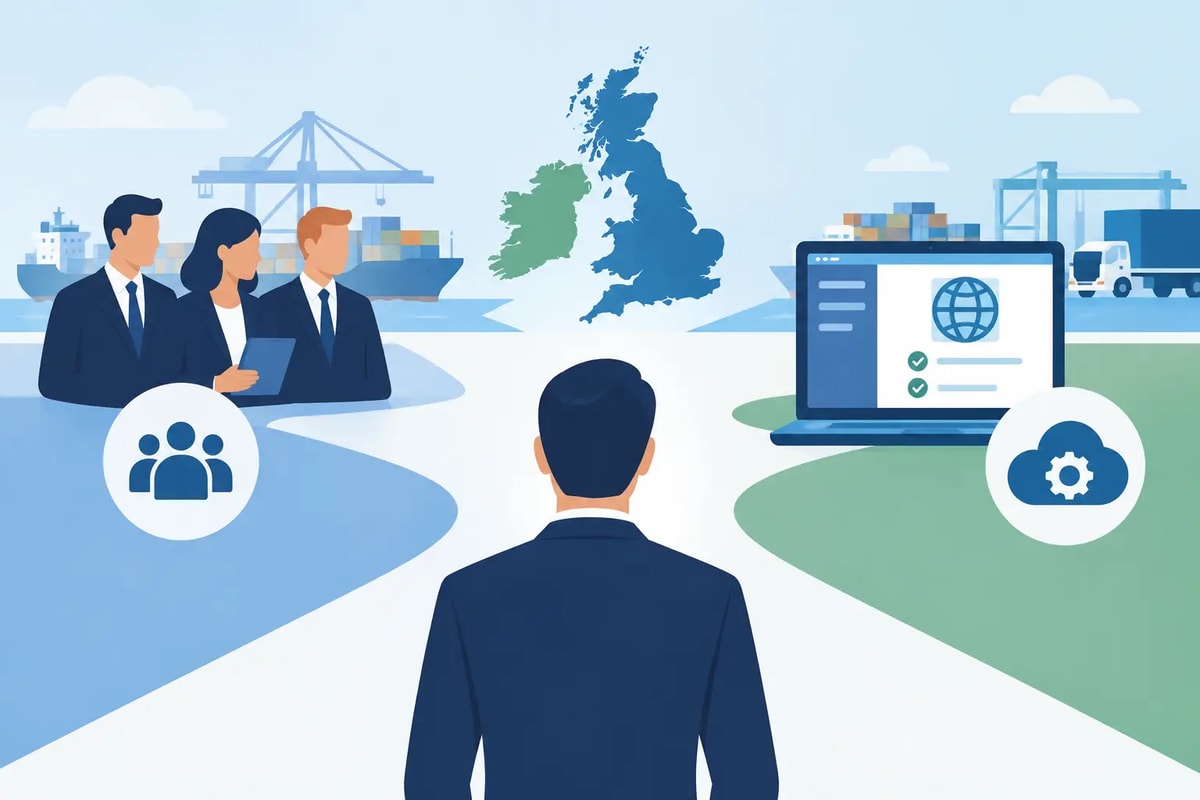
A delayed declaration can hold up a truck, disrupt a ferry booking or leave a customer waiting for goods. That is why the choice of agency versus software is not simply a purchasing decision. For UK and Ireland traders, it determines who owns the declaration process, how quickly issues can be resolved and how much customs knowledge sits within the business.
There is no single right answer. An outsourced customs agency can remove pressure from a lean team, particularly when trade volumes are irregular or requirements are unfamiliar. Customs software gives businesses greater visibility and control, and can make routine declarations quicker and more economical once staff are trained. For many operators, the practical answer is a hybrid model that combines in-house capability with expert support when needed.
Agency versus software: what are you choosing?
At its simplest, an agency model means instructing a customs agent to prepare and submit declarations on your behalf. Your team supplies the commercial and movement information, while the agent manages the declaration process and, depending on the agreed service, deals with queries and customs communications.
A software model enables your own staff to process customs declarations in-house. The business enters and validates information, submits declarations directly through connected customs systems and manages its own day-to-day workflow. This may cover import and export declarations, ENS, NCTS6, S&S GB, GVMS and PBN activity, depending on the movements you manage.
The difference is not that one option cares about compliance and the other does not. Both must produce accurate, timely declarations. The key distinction is operational responsibility. With an agency, much of the processing work sits outside your organisation. With software, your organisation has direct control over the work, the data and the timing.
That control can matter when goods are moving frequently through busy routes between Great Britain, Northern Ireland and Ireland. A missing commodity code, incorrect customs procedure code or incomplete valuation detail is easier to address when the people closest to the order, stock and transport plan can see the declaration status immediately. But direct access only helps if staff understand what they are looking at and have a clear process for handling exceptions.
When a customs agency is the sensible choice
Using an agency is often the right decision for businesses with low or unpredictable declaration volumes. If you import occasionally, are entering a new market or have no trained customs resource, outsourcing avoids asking a finance, logistics or customer service colleague to learn a complex process under time pressure.
It can also provide valuable reassurance for unusual or high-risk movements. A business may need help with a new commodity, preference claim, special procedure, temporary admission movement or a route it has not used before. An experienced agent can review the available information, identify gaps and explain what is required before goods reach the border.
Agency support is particularly useful where operational teams are stretched. A haulier dealing with last-minute collection changes, a forwarder coordinating several customers, or an SME with one person covering transport and administration may not have capacity to submit every declaration internally. Outsourcing turns customs processing into a managed service and gives the team a defined point of contact when a problem arises.
The trade-off is dependency. Your goods can only move as quickly as information reaches the agent and the agent can act on it. If an invoice, packing list, EORI number, authorisation reference or vehicle detail is missing, there may be several hand-offs before the declaration can be corrected. This is manageable with strong communication and agreed cut-off times, but it is still a consideration for time-critical traffic.
Cost should be considered beyond the price per declaration. Agency fees are often straightforward and appropriate for occasional users. At higher volumes, however, repeated processing charges can become a significant operating cost. Businesses should also consider the internal time spent compiling data, responding to queries and checking entries, even when an external agent submits the declaration.
When customs software gives better control
Customs software is normally most attractive when declaration volumes are regular, deadlines are tight and the business wants to build internal capability. Rather than sending data to a third party for each movement, trained staff can create declarations when the commercial and transport information is ready.
This provides visibility. The operator can see what has been submitted, what is awaiting action and what information is missing. That is useful for logistics managers trying to keep vehicles moving, as well as for finance and operations teams that need a reliable audit trail. Direct connections to systems such as HMRC CDS, CSPs and Irish Revenue ROS also reduce the need to re-key information across separate processes.
In-house processing can improve consistency when the same products, suppliers, customers and routes are used repeatedly. A well-configured system can support templates, saved data and validation prompts, helping users work through standard declarations efficiently. It does not remove the need for judgement, but it can make routine work easier to manage and reduce avoidable errors.
Software also keeps knowledge closer to the business. Your team becomes more familiar with commodity classification, origin, customs values, Incoterms and the evidence behind the information declared. This is valuable when customs questions arise after clearance, when reviewing duty spend or when a supplier changes the way goods are shipped.
The responsibility is greater, too. A software subscription does not make a declaration correct by itself. Businesses need trained users, documented processes, clear ownership of master data and a route for escalating difficult cases. If one administrator is the only person who understands the process, annual leave or staff turnover can quickly become an operational risk.
The questions that should shape the decision
The best model usually becomes clearer when you look at your actual movements rather than choosing based on a general preference for outsourcing or control. Start with volume and predictability. A business making a handful of declarations each month has different needs from a 3PL processing hundreds of entries across multiple customers and ports.
Next, assess complexity. Regular imports of the same finished goods may be suitable for a trained in-house team. Movements involving multiple commodity codes, controlled goods, changing origins, customs warehousing or special procedures may need more specialist input. Complexity does not rule out software, but it increases the value of accessible expert support.
Consider the consequences of delay. If a declaration issue means a vehicle misses a sailing, the cost is not just administrative. It may include storage, driver time, missed delivery slots and customer dissatisfaction. Businesses running time-sensitive movements need a process that gives them fast access to accurate information and someone who can act when an exception occurs.
Finally, be honest about internal capacity. Do you have staff who can be trained and given time to manage customs properly? Do they have access to reliable product, supplier and transport data? Can another colleague cover them? Building an in-house function is a sensible investment when the workload supports it, but it should be planned rather than added quietly to an already overloaded role.
Why a hybrid customs model often works best
The choice does not have to be permanent or absolute. Many businesses process their standard movements in-house and use an agency for peaks, unusual declarations or periods when internal staff are unavailable. This gives the business control over everyday activity without leaving it exposed when requirements fall outside normal practice.
A hybrid approach is also useful during onboarding. A company can begin by outsourcing declarations while staff complete training and learn the workflow. As confidence grows, it can bring selected declaration types in-house, starting with the most repeatable movements. Agency support then remains available for advice, checks and exception handling.
For a freight forwarder or 3PL, the model may vary by customer. Larger customers with established data and regular traffic may be suited to a software-led process. Smaller or occasional customers may need a managed agency service. The important point is to define who supplies each piece of information, who reviews it and who is accountable for submitting the declaration before the vehicle reaches the border.
Custran is built around this practical flexibility: software for businesses that want to process declarations in-house, alongside agency services, training and ongoing operational support for when human expertise is needed.
Build capability without creating new risk
If you choose software, treat implementation as an operational change rather than an IT project. Map the journey from order and invoice through to declaration, movement reference and post-clearance records. Identify where commodity codes, values, origin evidence and transport details come from, then decide who checks them.
Training should be specific to the movements your team handles. A colleague processing standard imports does not need the same depth of knowledge as someone managing transit movements or safety and security filings. Short, role-based training is usually more effective than expecting every user to become a customs specialist on day one.
If you use an agency, agree service levels and information cut-offs that reflect your transport operation. Make sure the agent receives accurate commercial documents early enough to query them, not minutes before a departure. Keep copies of declarations and supporting records accessible within your own business, because customs compliance remains a shared operational responsibility even when processing is outsourced.
The strongest customs setup is the one that matches your traffic, your people and your tolerance for risk. Choose an agency when you need hands-on execution, choose software when regular movements justify in-house control, and keep expert support close enough that an unexpected border issue does not become a business interruption.